
What One Subtitle in the Capital Budget Reveals
The Township’s 2026 Capital budget shows $177M in borrowing consolidated into its debt calculations despite previous public assurances it would have no impact.
In December I published an article ‘Willoughby Will Never Get Its Pool’, an investigation into Langley’s quickly diminishing credit limit. As a refresher, municipalities in BC all have a credit limit. They can spend no more than 25% of their property tax revenue servicing debt.
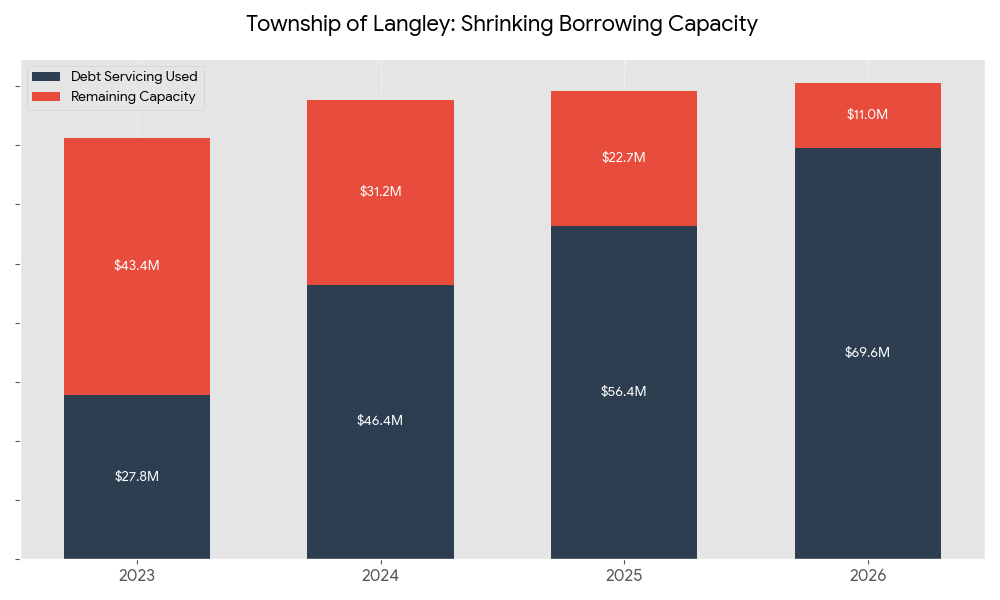
A key item in that article was the Township of Langley Housing Trust Society (THTS), a consolidated entity wholly owned and controlled by the Township for the purpose of building housing, through a model of partnering with BC Housing, taking on debt, and securing grants. There are three projects under development totalling 368 residential units and a few commercial units. Of the residential units, 74 are priced 20% below market rate, largely subsidized by the Province through grants.
Because THTS is a separate legal entity, it cannot be FOI’d. At the time of my article I had roughly estimated THTS had borrowed about $120M, and that this was crowding out debt room for the Willoughby Community Centre – something now confirmed.
Eric Woodward Says I am Wrong
My article prompted a discussion in council chambers about how THTS impacts the Township’s borrowing limit. When Councillor Martens asked about THTS borrowing, Mayor Woodward responded: (See on YouTube here)
I think we have to be very cautious to be reflecting information that we see that’s inaccurate being distributed to the public, I think for a very clear agenda. The housing trust does not have a net impact on the borrowing limit for the Township of Langley … I would caution the public to, you know, again, continue to consume information that they get from individuals that just don’t know what they’re talking about.
More Information Comes Out
After my article I submitted a FOI request to the Township asking for the most recent Liability Servicing Limit Certificate. This is essentially a certificate submitted to the Province that outlines all the borrowing the Township has taken out and confirms that it complies with the 25% credit limit.
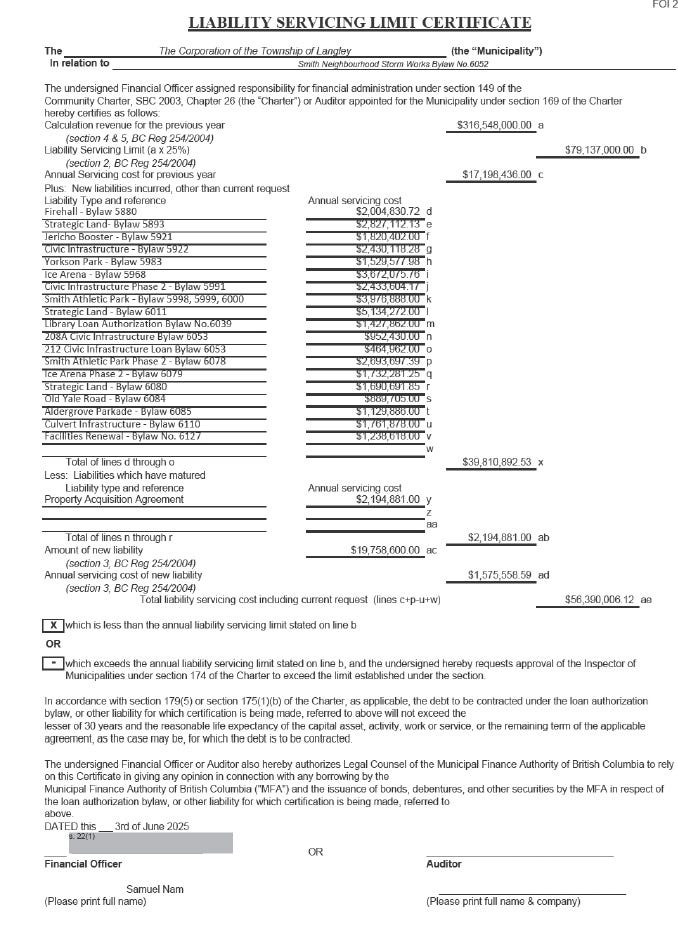
Two things stand out. First, the most recent LSLC shows no borrowing for the housing trust, despite projects already underway. Second, the Township had roughly $22.7M in servicing limit remaining ($79.1M – $56.4M), with no new borrowing since.
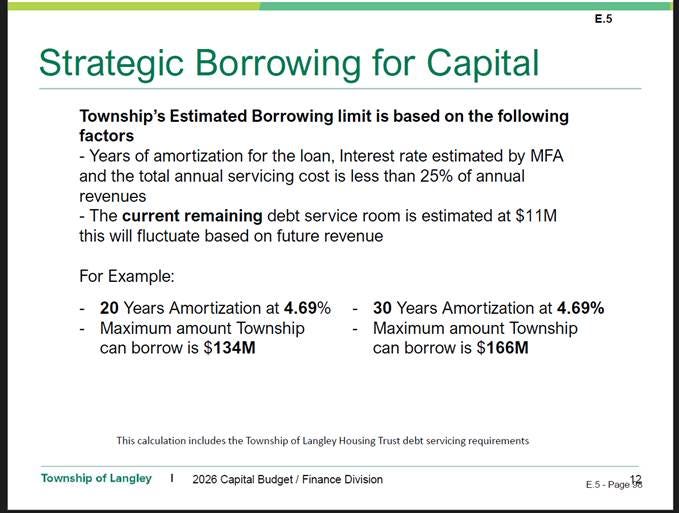
Every year the capital budget includes a slide showing remaining borrowing capacity. This year’s slide contains something new: the line “This calculation includes the Township of Langley Housing Trust debt servicing requirements.” It also shows $11.7M less in available servicing room which corresponds to roughly $177M in lost borrowing capacity.
Quick explainer: the liability servicing limit is measured in how many dollars per year can you spend servicing debt. $11.7M over 30 years is ~$177M.
So why is our debt servicing capacity down $177M once consolidated with the housing trust? I thought this all netted to zero?
The Mayor is Wrong on This
This isn’t the first time Eric has publicly announced I’m wrong only to be proven otherwise. In December he told council I didn’t understand developer fees but it turned out he was the one who didn’t understand them. Had he listened, the Township would have $64.5M of additional financial flexibility (see full article).
Now add in the $177M from the THTS and the above and there is $242M of financial mistakes Eric Woodward has made and announced in council that I am wrong about only for me to eventually be proven right.
I should be clear too. I have a degree in Accounting and Finance but I am no expert in any of these areas. I just read council agendas and ask questions. The fact that I keep being proven right while Eric has a team of municipal lawyers and accountants at his disposal says something.
There is a pattern where Eric will fundamentally not understand the financial implications of his decisions and will loudly talk down the people that try to point out what he is doing wrong.
His point about the THTS netting to zero is not a recognized concept in municipal finance. Feel free to read the Municipal Liabilities Regulation. There is no ‘netting’ against expected revenue, it’s only the gross liability that is counted.
So is the Debt Authorized?
Borrowing for capital projects follows a path prescribed in the community charter, the legislation that governs the Township. There are three main sections that govern the flow of borrowing.
Section 174 – borrowing cannot be taken out unless it’s already accounted for in the 5 year financial plan.
Section 179 – municipal government must authorize a borrowing bylaw for capital borrowing.
Section 180 – borrowing requires electoral approval, usually done through an Alternative Approval Process (AAP). There is an AAP free zone that was just updated by the province to be 10%. The Township is well over this number so almost all borrowing needs electoral approval.
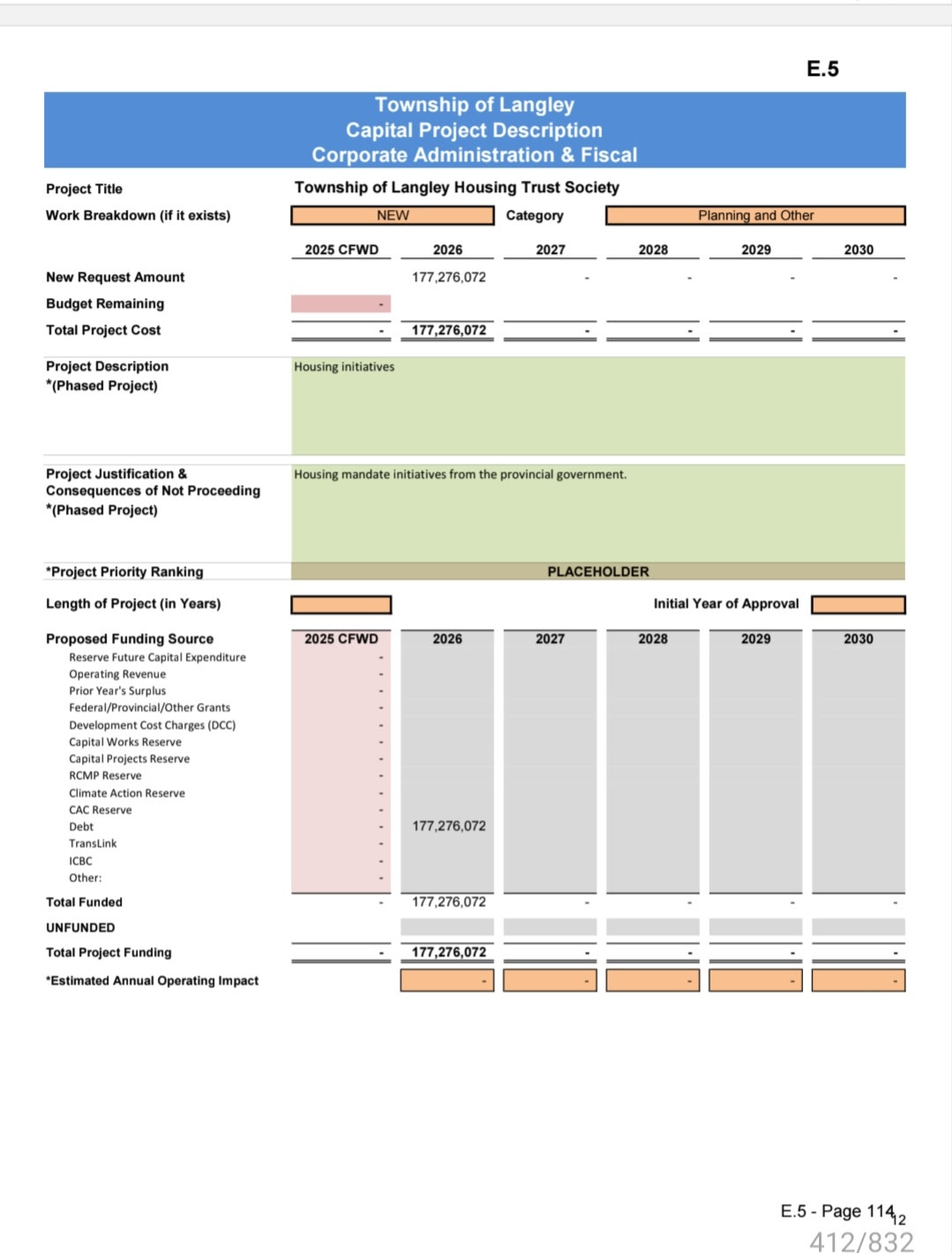
What we know is the township has borrowed $177M for the housing trust. There have been no borrowing bylaws, no electoral approval and until last week hasn’t shown up in any financial plans.
I want to be clear here because this is the end of where the paper trail ends. I am not a lawyer but from talking to insiders and my own research can infer what I think is happening.
The timing is notable. The Liability Servicing Limit Certificate did not reflect this borrowing. Following a Section 172 complaint to the municipal auditor, the treatment appears to have changed within weeks.
I have no direct evidence of what occurred behind the scenes. However, the sequence suggests that the Township’s interpretation of how this borrowing impacts the Liability Servicing Limit may have been reconsidered.
Adding the housing trust to the current financial plan is the first step to passing a borrowing bylaw and an eventual AAP. The charter is forward looking with debt, if this is an attempt at curing it implies the debt is unauthorized.
The Charter treats unauthorized expenditures seriously. Section 191 outlines consequences where spending is authorized contrary to the Act.
Residents must have clarity from the Township on what is happening to answer these questions because of the seriousness of the consequences.
Wrapping it Up
This isn’t an isolated mistake. It’s part of a pattern: $242M in financial decisions made without proper process, flagged by a citizen with a blog while the Mayor’s team of lawyers and accountants looked the other way. At some point “we didn’t know” stops being an excuse and starts being the story. We should get answers on what is going on with the THTS debt, why is it impacting our Liability Servicing Limit without traditional approval steps?
The Township is in a capital crunch, with limited borrowing room remaining and drained reserves; this has real impact on the facilities and infrastructure the Township can deliver residents. This could be the room needed for the performing arts centre or for the completion of 202St, suddenly there isn’t enough capital room for both these projects.
Langley residents should be asking who is actually minding the finances of this Township and whether it’s time for someone new to do it.